

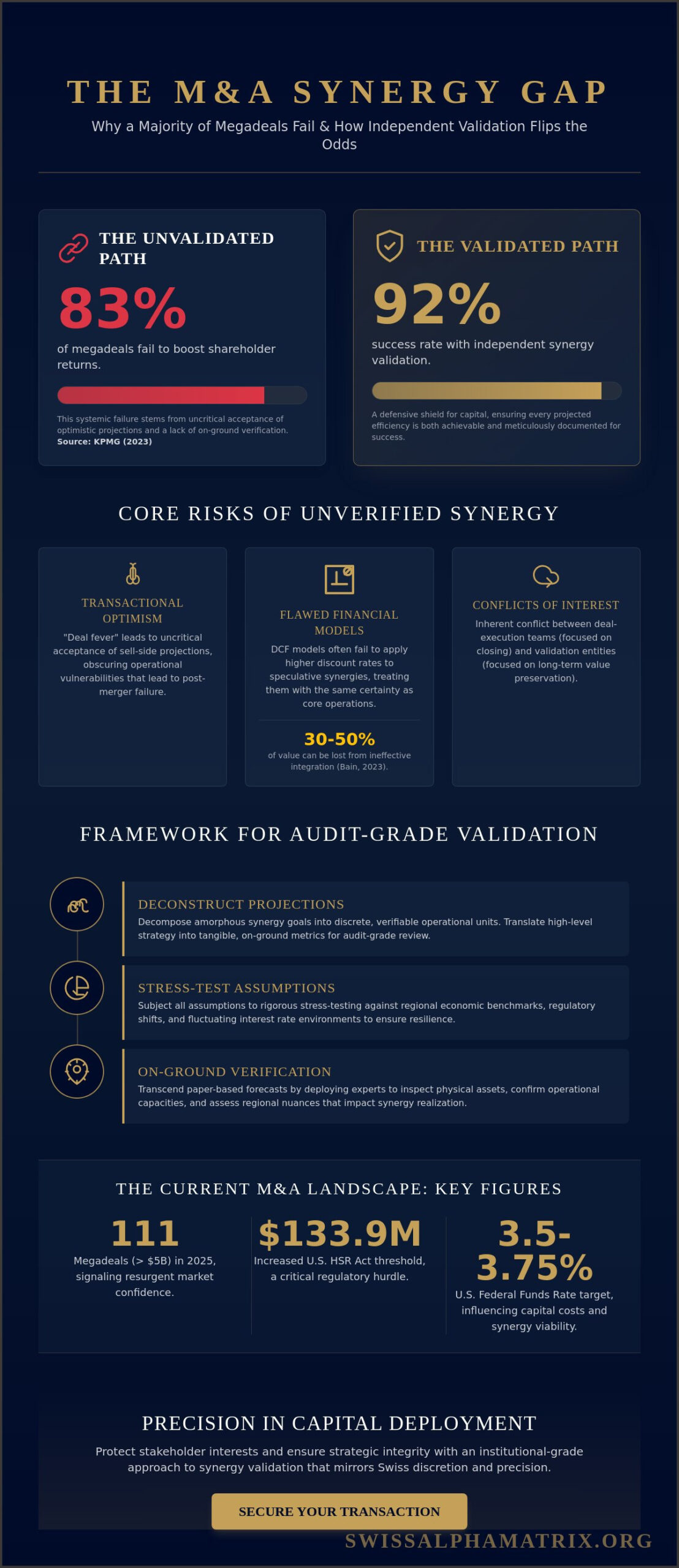
While the resurgence of megadeals has reset market confidence, with 111 transactions exceeding $5 billion in 2025, the historical precedent that 83% of such deals fail to boost shareholder returns serves as a necessary caution for the discerning institutional entity. You likely understand that the allure of strategic expansion can occasionally obscure the underlying operational vulnerabilities that lead to post-merger integration failure. This analysis demonstrates how independent synergy validation in m&a provides a defensive shield for capital, utilizing audit-grade verification to ensure that every projected efficiency is both achievable and meticulously documented. It’s documented that deals where synergies are explicitly validated and tracked from inception enjoy a 92% success rate, a stark contrast to the broader market’s frequent underperformance. We’ll examine the specific pillars of on-ground verification and the risk management frameworks required to navigate a landscape where U.S. HSR Act thresholds have risen to $133.9 million; ensuring your transaction maintains its strategic integrity despite shifting regulatory and interest rate environments.
Key Takeaways
- Identify the methodology for decomposing amorphous synergy projections into discrete, verifiable operational units to mitigate the psychological influence of transactional optimism.
- Implement a structured framework for synergy validation in m&a that utilizes rigorous stress-testing against regional economic benchmarks to ensure long-term capital preservation.
- Discern the critical impact of international financial regulations and regional operational nuances on synergy realization within complex, cross-border acquisitions.
- Recognize the strategic imperative of independent project oversight to eliminate inherent conflicts of interest between deal-execution teams and validation entities.
- Adopt a sophisticated approach to operational due diligence that mirrors the precision and traditional discretion of institutional-grade financial advisory.
The Synergy Trap: Why Transactional Optimism Threatens Capital Preservation
The pursuit of strategic growth through acquisition often encounters a pervasive psychological hurdle: the erosion of objectivity in the face of transactional momentum. This phenomenon, frequently described as “deal fever,” manifests as an uncritical acceptance of optimistic synergy projections, which are often provided by sell-side entities with inherent incentives to maximize valuation. Statistics from KPMG (2023) suggest that approximately 83% of M&A transactions fail to enhance shareholder returns, a figure that highlights the systemic gap between projected efficiencies and realized operational gains. Relying exclusively on investment bank forecasting models without independent synergy validation in m&a introduces a profound risk of capital erosion. This process shouldn’t be viewed as a mere administrative checkbox; it’s a core component of a defensive risk management framework designed to protect institutional interests and ensure long-term preservation.
The Flaw in Traditional DCF Models
Traditional Discounted Cash Flow (DCF) models frequently suffer from a structural vulnerability where terminal value calculations mask the inherent fragility of near-term synergy assumptions. Many analysts fail to apply a distinct, higher discount rate to synergy-linked cash flows, treating these speculative gains with the same certainty as established core operations. In complex cross-border contexts, these “paper synergies” often dissolve when confronted with local labor laws or fragmented IT infrastructures. This demonstrates that a model’s mathematical elegance is no substitute for on-ground verification. Without rigorous stress-testing, the anticipated value of a deal, which Bain (2023) notes can be lost by 30% to 50% due to ineffective integration, remains an unmitigated risk on the balance sheet.
Fiduciary Responsibility in M&A Oversight
Fiduciary responsibility dictates that a board of directors must move beyond the superficial assurances of standard due diligence. Protecting stakeholder interests requires a shift toward audit-grade validation, where senior-level experts provide an unemotional review of every operational assumption. By demanding independent verification, leadership ensures that capital deployment remains a disciplined exercise in strategic growth rather than a speculative venture driven by transactional momentum. Effective oversight involves several key actions:
- Mandating the decomposition of synergy categories into verifiable operational units.
- Requiring stress-testing of assumptions against regional regulatory and economic benchmarks.
- Establishing a clear distinction between deal-making teams and the validating entities to eliminate conflict of interest.
This level of rigour is essential for maintaining the strategic integrity of the organization, particularly when navigating the intricate dynamics of the current global market. It ensures that the board isn’t merely reacting to market trends, such as the surge in megadeals, but is instead acting as a protective authority for the firm’s long-term health.
A Strategic Framework for Independent Synergy Validation
The implementation of a defensive framework for synergy validation in m&a requires a departure from the superficial assessments often found in standard due diligence, moving instead toward a methodology characterized by institutional-grade rigour. To satisfy the mandate of executive fiduciary duty, a five-phase strategic approach ensures that every assumption is subjected to audit-grade scrutiny before capital is committed to a transaction. While the initial phases focus on the granular decomposition of synergy categories into discrete, verifiable operational units, the subsequent stages involve rigorous stress-testing against regional regulatory and economic benchmarks. This is particularly vital in the current climate, where the U.S. Federal Funds Rate target range of 3.50% to 3.75% directly influences the cost of capital and the hurdle rates for synergy-driven initiatives. By utilizing on-ground verification services to inspect physical assets and confirm operational capacities, leadership can transcend the limitations of paper-based forecasts and secure the transaction’s strategic integrity.
- Phase 1: Decomposition of amorphous synergy projections into discrete, line-item operational units.
- Phase 2: Stress-testing financial assumptions against regional interest rates and regulatory constraints.
- Phase 3: Direct verification of physical assets and operational capacities via localized expertise.
- Phase 4: Quantifying execution risk and the associated friction costs of cross-border integration.
- Phase 5: Delivery of audit-grade reporting to facilitate unemotional executive decision-making.
Deconstructing Cost and Revenue Assumptions
Validating projected headcount reductions requires more than simple arithmetic; it necessitates a profound understanding of local labor laws and the associated severance costs that can rapidly erode anticipated savings, particularly in jurisdictions with robust worker protections. In the 2026 landscape, assessing economies of scale demands a meticulous review of supply chain logistics, where geopolitical fragmentation may counteract the theoretical benefits of consolidation. Revenue cross-marketing assumptions in disparate markets also require significant rigour, as a Geneva-based operational model rarely mirrors the consumer dynamics of Hong Kong without extensive, localized adaptation. It’s through this level of technical accuracy that an organization avoids the “paper synergies” that lead to post-merger failure and capital erosion.
The Role of Audit-Grade Instrument Validation
The financial integrity of a complex acquisition is only as robust as the instruments that underpin the capital structure. Utilizing bank instrument validation services ensures that the guarantees, collateral, and liquidity sources involved in the transaction are authenticated and fully aligned with the overarching strategic goals. This level of verification is particularly critical in cross-border deals where the transparency of financial assets can be obscured by regional differences in reporting standards. By linking instrument validation to the broader synergy framework, leadership can proceed with the confidence that the deal’s foundations are as secure as its projected outcomes, maintaining the standard of excellence expected by institutional stakeholders.
Cross-Border Complexity: Validating Synergies in Global Markets
Global market integration introduces a layer of friction that often remains invisible during the initial valuation phase. While a centralized strategy might suggest seamless consolidation, the practical application of synergy validation in m&a must account for the divergent realities of disparate jurisdictions. The recent publication of the EU’s draft merger guidelines on April 30, 2026, which introduce a standalone 25% market share threshold for horizontal mergers, exemplifies how shifting international financial regulations can abruptly alter the feasibility of anticipated cost savings. Navigating these complexities requires more than digital oversight; it demands an on-ground presence to bridge the transparency gap that frequently characterizes emerging market acquisitions. This meticulous approach ensures that capital preservation remains the primary objective, even when the allure of market expansion is at its peak.
The operational failure of a Geneva-based model when transplanted to Hong Kong illustrates the danger of ignoring regional nuances. Local labor customs, supply chain peculiarities, and divergent consumer behaviors create a landscape where theoretical economies of scale often fail to materialize. Without physical on-ground verification of intangible synergy claims, such as brand equity or market access, an institutional buyer risks overpaying for assets that cannot deliver the projected returns in their specific geographic context. It’s only through a disciplined, unemotional review of these localized factors that the strategic integrity of a cross-border transaction can be maintained.
Operational Due Diligence in Foreign Jurisdictions
Evaluating the capability of local management to execute complex integration programmes is a cornerstone of protecting capital. This process involves a technical verification of IT infrastructure and cybersecurity standards, ensuring that cross-border data flows remain both secure and compliant with local privacy mandates. Adopting a methodology for mastering cross-border investment due diligence allows for a granular assessment of these risks before they manifest as post-close liabilities. It’s a standard of service that prizes technical accuracy over the frantic energy often associated with high-stakes deal-making.
Regulatory and Compliance Hurdles
The financial burden of Anti-Money Laundering (AML) and Know Your Customer (KYC) compliance in unfamiliar territories can significantly erode the net value of synergies. As of February 17, 2026, the U.S. HSR Act antitrust notification threshold has increased to $133.9 million, adding another layer of regulatory scrutiny for transactions of a certain magnitude. Geopolitical shifts and the resulting volatility in tax policies further necessitate a risk management framework that prioritizes long-term stability over the immediate allure of aggressive growth. By maintaining a measured, logical approach to these hurdles, the master planner ensures that every dollar of deployed capital is anchored by regional precision and institutional rigour.
The Case for Independent Project Oversight and Validation
The integrity of a transaction is fundamentally compromised when the same team responsible for deal execution is also tasked with validating its underlying assumptions. This inherent conflict of interest often leads to a dilution of rigour, as the momentum toward completion can overshadow the objective assessment of operational risks. A truly defensive posture requires the engagement of a third party characterized by “discreet authority,” capable of conducting sensitive cross-border investigations without the bias of transactional success fees. By integrating independent financial project management into the deal lifecycle, institutional buyers ensure that synergy validation in m&a remains a sober exercise in capital protection rather than a justification for deal-fever. This separation of powers is essential for maintaining the standard of excellence expected by high-net-worth individuals and institutional entities.
The involvement of seasoned experts, particularly those with backgrounds in Tier-1 banking, provides a level of oversight that internal teams simply cannot replicate. These professionals possess the institutional memory and technical accuracy required to identify subtle anomalies in synergy forecasts that might otherwise go unnoticed. Their presence serves as a reassuring anchor for stakeholders, signaling that the transaction is being guided by unemotional experts who prioritize long-term preservation over short-term speculation. It’s a measured, steady approach that lead the reader through a structured argument for the methodology, creating a sense of professional calm in high-stakes environments.
Establishing a Defensive Validation PMO
A Project Management Office (PMO) dedicated specifically to validation creates a structured environment for accountability. By utilizing a RACI matrix, the organization clearly defines who is responsible for each synergy lever, ensuring that accountability is never fragmented. This milestone-based approach ensures that capital is released only upon the verification of progress, preventing the common pitfall of front-loading value that never materializes. It’s a methodical process that mirrors the traditional discretion of high-end private wealth management, focusing on regional precision and meticulous attention to detail at every stage of the integration.
Audit-Grade Reporting for the Board
Executive decision-makers require more than high-level summaries; they need detailed, evidence-backed validation reports that withstand the scrutiny of institutional lenders. Independent oversight provides the critical “red flag” analysis that internal proponents might inadvertently overlook. Such reporting enhances the credibility of the transaction, demonstrating a commitment to technical accuracy and a refusal to oversimplify the complex dynamics of cross-border integration. For those seeking to fortify their transactional rigour, engaging complex project management services ensures that every strategic pillar is anchored by verified data and institutional-grade standards.
Precision in Capital Deployment: The Swiss Alpha Matrix Approach
Swiss Alpha Matrix operates with a standard of precision that mirrors the traditional discretion of high-end private wealth management, applying Tier-1 banking rigour to the intricate process of synergy validation in m&a. We recognize that the delta between a successful acquisition and a failed integration often lies in the quality of the data used during the initial phase. Our methodology for institutional-grade financial advisory moves beyond the digital representations of assets, prioritizing on-ground verification services to bridge the gap between financial models and physical reality. This approach ensures that capital deployment is guided by senior-level executive intelligence, protecting global interests from the systemic failures often associated with unverified transactional optimism.
The role of seasoned experts in this process cannot be overstated. By leveraging a protective authority rooted in historical reliability, we provide the technical accuracy necessary to navigate an environment where interest rates and regulatory thresholds, such as the $133.9 million HSR Act minimum, are in constant flux. Our commitment to regional precision allows us to identify operational vulnerabilities that automated systems or junior-level analysts might overlook. It’s a measured, steady pace that leads to a structured argument for the methodology, creating a sense of professional calm that encourages confidence in the most complex decision-making processes.
Protecting Capital through Meticulous Detail
Our complex project management framework is designed to ensure deal integrity from the initial mandate through to the final close. Each due diligence programme is customized to the specific requirements of the transaction, acknowledging that a uniform approach is insufficient for the nuances of cross-border mandates. We offer an implicit promise of exclusivity, where every detail is examined with the meticulous attention required to preserve the strategic health of the firm. By maintaining this high-level standard, we distinguish a performance-oriented mindset from passive market participants, ensuring your interests are in the hands of seasoned, unemotional experts.
Engaging Swiss Alpha Matrix for Strategic Oversight
We operate on a milestone-based advisory model, aligning our success with the successful protection of your capital. This structure ensures that our global network of senior financial experts remains focused on the long-term preservation of value rather than the immediate completion of the deal. For those requiring a sophisticated partner to oversee the complexities of a multi-jurisdictional acquisition, we invite you to contact our senior partners for a confidential consultation on your next transaction. Our standard of service is both broad in reach and meticulous in its attention to detail, providing the high-level access and stability required for significant capital growth.
Fortifying Transactional Integrity for Future Growth
Success in the current global market isn’t found in the speed of the transaction but in the depth of its verification. By establishing a clear separation between deal execution and oversight, institutional leadership can effectively neutralize the psychological biases that often lead to capital erosion. Implementing a rigorous framework for synergy validation in m&a ensures that every operational assumption is anchored by physical reality rather than speculative forecasting. This commitment to transactional rigour, supported by on-ground verification and independent project management, remains the most reliable safeguard against the complexities of global market fragmentation.
Led by former Tier-1 global banking executives, Swiss Alpha Matrix provides the specialized oversight necessary for complex cross-border mandates where capital preservation is the paramount concern. Our independent advisory serves as a protective authority, offering the master planning required to navigate shifting regulatory landscapes with absolute confidence. Secure your next transaction with audit-grade synergy validation from Swiss Alpha Matrix. We look forward to providing the high-level access and meticulous oversight required to ensure your next strategic acquisition delivers the enduring value your stakeholders expect.
Frequently Asked Questions
What is the primary difference between synergy estimation and synergy validation?
The primary distinction lies in the transition from theoretical forecasting to empirical verification. While synergy estimation typically involves high-level modeling of potential efficiencies based on top-down assumptions, synergy validation in m&a requires a granular, bottom-up analysis to confirm that these projections are anchored by operational reality. This process involves stress-testing every assumption against actual site capacities and localized economic constraints to ensure that the proposed value is inherently achievable.
Why is independent oversight critical for cross-border M&A synergy validation?
Independent oversight is essential because it removes the inherent bias of deal-execution teams whose incentives are often aligned with transaction completion rather than long-term capital preservation. In cross-border environments, an independent entity provides the discreet authority needed to navigate regional transparency gaps and verify intangible claims. This objective perspective is critical for identifying risks that internal proponents might inadvertently minimize during the momentum of a megadeal.
How does audit-grade validation protect a company’s board of directors?
Audit-grade validation serves as a robust defensive framework that fulfills the board’s fiduciary duty to protect stakeholder interests. By demanding independent verification of deal assumptions, directors can demonstrate a standard of care that exceeds superficial due diligence. This unemotional, expert review mitigates the risk of overpaying due to inflated forecasts. It shields the board from potential accusations of negligence in high-stakes capital deployment.
Can synergy validation be conducted post-transaction, or must it be pre-close?
While preliminary validation should ideally occur pre-close to inform the final valuation and prevent capital erosion, the process must continue post-transaction to track realization. Pre-close validation identifies the feasibility of gains, while post-close oversight ensures that integration milestones are met. Maintaining this continuity of rigour is vital for translating paper synergies into tangible shareholder returns over the critical three-year horizon where most deals traditionally falter.
What are the most common red flags found during the validation of cost synergies?
Frequent red flags include the systemic underestimation of local labor law complexities and the associated severance costs in jurisdictions with high worker protections. Analysts often discover that economies of scale are negated by supply chain fragmentation or the technical friction of integrating disparate IT infrastructures. These operational hurdles can consume significant portions of a deal’s anticipated value, making early identification through synergy validation in m&a a strategic imperative.
How does physical on-ground verification impact the valuation of operational synergies?
Physical on-ground verification provides a layer of technical accuracy that digital data rooms cannot replicate. By inspecting physical assets and interviewing local management, experts can confirm that the operational capacities described in the prospectus actually exist and are functional. This direct observation often reveals maintenance backlogs or regional nuances that significantly impact the true valuation of projected operational efficiencies, ensuring that capital isn’t deployed based on outdated or inaccurate data.
What role does a PMO play in the successful realization of validated synergies?
A dedicated Project Management Office (PMO) serves as the structural anchor for accountability through the use of a RACI matrix. It ensures that synergy capture isn’t treated as a secondary task but as a primary strategic pillar with defined milestones and owners. By linking progress to the release of capital, the PMO creates a disciplined environment where the realization of validated gains is meticulously tracked and reported to executive leadership with institutional-grade precision.
How should a company account for implementation costs during the validation process?
Implementation costs should be meticulously quantified and treated as a direct deduction from the net present value of the synergies. This includes accounting for integration friction, regulatory compliance fees, and the one-time expenses required to achieve recurring savings. A sophisticated validation process ensures these costs aren’t buried in operational budgets but are transparently modeled to reflect the true net benefit of the transaction to the acquiring entity.