

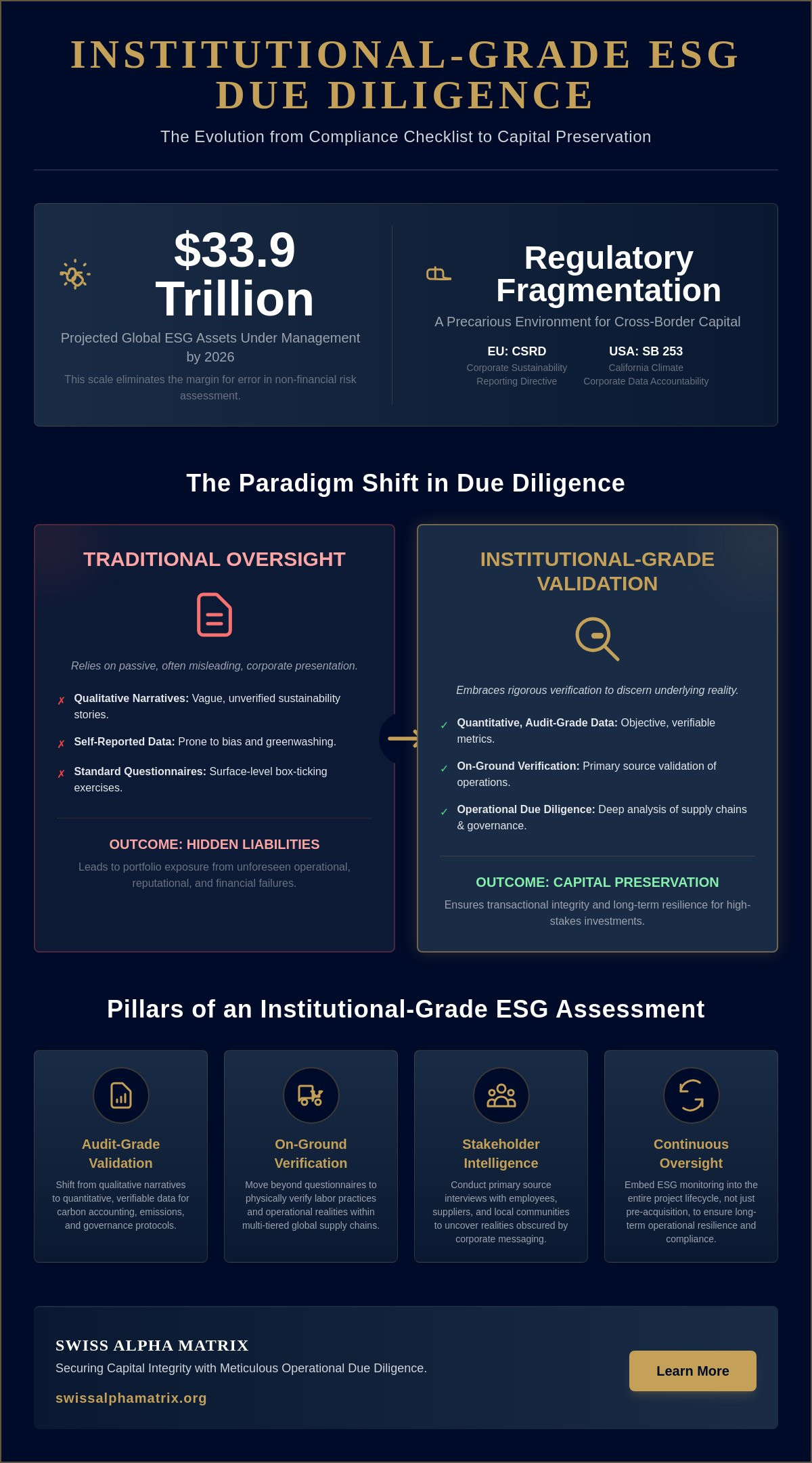
With global ESG-related assets under management reaching $33.9 trillion in 2026, the margin for error in assessing non-financial risk has effectively vanished. You likely recognize that the prevailing climate of regulatory fragmentation, catalyzed by the simultaneous activation of the EU’s Corporate Sustainability Reporting Directive and California’s SB 253, renders traditional oversight insufficient. The pervasive reliance on unreliable, self-reported data from target entities frequently exposes institutional portfolios to hidden supply chain failures and the severe reputational liabilities associated with greenwashing. It’s a complex reality that demands more than a cursory review; it requires a sophisticated approach to environmental social governance (esg) due diligence that prioritizes technical precision over mere corporate presentation.
This article provides the intellectual depth necessary to master audit-grade validation and ensure long-term capital integrity in your cross-border investments. By moving beyond passive reporting and embracing rigorous on-ground verification and operational due diligence, you can effectively mitigate transactional risk while satisfying the most stringent regulatory mandates. We’ll examine the strategic pillars required to transform ESG from a reporting obligation into a robust mechanism for capital preservation. This framework offers the technical accuracy and seasoned perspective needed to justify your most significant capital deployment decisions to stakeholders who value permanence and strategic growth.
Key Takeaways
- Understand the imperative shift from qualitative sustainability narratives to quantitative, audit-grade data as the primary mechanism for validating transactional integrity in 2026.
- Learn how to execute robust environmental social governance (esg) due diligence by moving beyond standard questionnaires toward on-ground verification and primary source stakeholder interviews.
- Discover the methodology for embedding continuous ESG oversight into the lifecycle of complex financial project management. It’s the most effective path to ensuring long-term operational resilience.
- Identify the structural risks associated with global regulatory fragmentation and how a formal risk management framework protects against the reputational liabilities of greenwashing.
- Gain insights into the Swiss Alpha Matrix approach for aligning international financial regulations with meticulous operational due diligence to preserve capital in high-stakes environments.
The Evolution of ESG Due Diligence: From Compliance to Capital Preservation
The historical perception of Environmental, social, and governance (ESG) as a peripheral compliance exercise has been decisively superseded by a mandate for capital preservation. In 2026, sophisticated investors no longer view these factors as elective; they recognize them as fundamental indicators of a target’s structural integrity. This transition marks the end of an era defined by qualitative, self-reported narratives. It ushers in a period where environmental social governance (esg) due diligence must yield quantitative, audit-grade data capable of withstanding the scrutiny of institutional risk committees. Tier-1 entities now interpret a firm’s ESG performance as a definitive proxy for the caliber of its management and the resilience of its operational architecture. Within this high-stakes environment, the application of Swiss precision and discretion becomes paramount, specifically when conducting sensitive cross-border investigations that require a nuanced understanding of regional complexities.
Institutional leaders now prioritize several key performance indicators during their assessment phase:
- Audit-grade instrument validation for carbon accounting and emissions tracking.
- On-ground verification of labor practices within multi-tiered, global supply chains.
- Quantitative assessment of board-level governance and anti-corruption protocols.
The 2026 Regulatory Landscape
The current year represents a regulatory watershed. The simultaneous enforcement of the EU’s Corporate Sustainability Reporting Directive (CSRD) and California’s SB 253 has fundamentally altered global deal flow. These mandates require companies to provide third-party verified disclosures, effectively ending the period of voluntary participation. However, the resulting regulatory fragmentation across jurisdictions creates a precarious environment for cross-border capital. Navigating this requires a meticulous regulatory compliance advisory approach. The stakes extend far beyond financial penalties; failure to align with these evolving standards often results in the immediate revocation of an institution’s metaphorical license to operate within key markets.
ESG as a Risk Mitigation Tool
Rigorous ESG assessment serves as a critical early warning system for the modern investor. By conducting detailed operational due diligence, investors can uncover hidden liabilities that traditional financial audits frequently overlook. These might include latent supply chain vulnerabilities or systemic governance failures that precede catastrophic operational collapses. A robust risk management framework doesn’t just check boxes. It actively identifies the link between lax governance standards and the potential for financial fraud. It’s a proactive defense that ensures capital is deployed only into entities with verifiable moral and operational character, thereby protecting the long-term integrity of the portfolio.
The Pillars of Institutional-Grade ESG Assessment
The structural integrity of a truly institutional assessment resides in its transition from passive observation to the rigorous discipline of complex project management. It’s no longer sufficient to merely solicit responses through digital questionnaires; instead, a sophisticated practitioner must engage in primary source verification and exhaustive stakeholder interviews to discern the underlying reality that often remains obscured by corporate presentation. This methodology represents a Strategic Imperative in Mergers & Acquisitions, especially when capital is deployed across jurisdictions characterized by disparate oversight standards. Successfully mastering cross-border investment due diligence requires a bespoke lens that prioritizes sector-specific materiality, ensuring that environmental social governance (esg) due diligence focuses precisely on the variables most likely to jeopardize long-term capital integrity.
Environmental Resilience and Climate Risk
Environmental Resilience is the ability of an asset to maintain value under extreme ecological shifts. Within the framework of institutional-grade environmental social governance (esg) due diligence, this necessitates a granular evaluation of both physical climate risks and the more subtle transition risks that accompany shifting energy policies. For infrastructure and long-term capital projects, these shifting policies can fundamentally alter asset valuations, making it essential to model various regulatory trajectories to avoid the acquisition of stranded assets.
Social License and Labour Integrity
A project’s social license is frequently its most fragile asset, yet it remains the most difficult to quantify. Sophisticated supply chain auditing must penetrate deep into global projects to detect indicators of modern slavery or labor exploitation, as these failures carry the potential for catastrophic reputational damage and the subsequent erosion of brand equity. Ensuring that a project maintains its social license to operate involves a meticulous assessment of community engagement strategies, confirming that the entity’s presence is perceived as a stable, long-term contribution to the local ecosystem rather than a transient, extractive force.
Governance: The Bedrock of Transactional Integrity
Governance serves as the definitive bedrock of transactional integrity, yet it is precisely where many standard assessments fail to provide sufficient depth. By integrating these evaluations with bank instrument validation services, we ensure that the financial underpinnings of a target entity are as resilient as its ethical architecture. This process involves a thorough verification of anti-money laundering and anti-corruption measures while simultaneously scrutinizing board-level oversight to confirm that the ethical framework is not merely a ‘paper shield’ but an active operational reality. For entities prioritizing these standards, engaging with a partner that specializes in operational due diligence ensures that these governance pillars remain unassailable throughout the investment lifecycle.
Beyond the Questionnaire: The Necessity of On-Ground Verification
The prevailing reliance on standardized Due Diligence Questionnaires (DDQs) has given rise to the ‘Paper Shield’ fallacy, a condition where digital documentation and polished corporate narratives serve as sophisticated veils rather than windows into operational reality. While these digital trails satisfy basic compliance checklists, they often mask deep-seated operational risks that only become apparent through physical proximity. In the high-stakes environment of 2026, where transactional integrity is the primary defense against capital erosion, environmental social governance (esg) due diligence must transcend the desktop review. By merging traditional financial discipline with meticulous physical on-site inspections, we can discern the subtle discrepancies between a target’s ‘as-stated’ ESG profile and its ‘as-is’ operational state. This level of scrutiny is essential for verifying the veracity of claims through direct observation and the cultivation of local intelligence, specifically in jurisdictions where regulatory oversight remains inconsistent.
The Limits of Self-Reporting
Corporate obfuscation has reached a new level of technical sophistication, making ‘greenwashing’ harder to detect through traditional auditing alone. It’s a fundamental reality that third-party audits are inherently limited by the specific parameters of access and data provided by the target entity. Red flags in ESG reports, such as statistical anomalies in Scope 3 emissions or a lack of granular detail regarding indirect supply chain labor, often trigger the necessity for an escalated investigation. When self-reported data suggests a perfection that contradicts regional norms, the risk of hidden liabilities increases, necessitating a shift toward independent verification to protect the integrity of the investment.
The On-Ground Methodology
A truly institutional environmental social governance (esg) due diligence methodology prioritizes the acquisition of executive-level intelligence through direct physical asset inspection. This process involves navigating complex regulatory environments using expertise honed in Tier-1 global banking to verify that the ‘social license’ discussed in the boardroom is actually reflected on the factory floor. By engaging in local stakeholder verification and physical site assessments, we provide the technical accuracy required for final investment decisions. This on-ground perspective ensures that capital is not deployed based on a digital paper trail, but on a verified foundation of operational excellence and moral character. It’s this measured, steady approach to on-ground verification that distinguishes a performance-oriented mindset from passive participation in the ESG market.
Integrating ESG into Complex Financial Project Management
The efficacy of environmental social governance (esg) due diligence isn’t merely determined by the depth of the initial audit but by how seamlessly these findings are woven into the operational fabric of the investment. For the institutional investor, this integration occurs most effectively within the framework of independent financial project management, where sustainability mandates are treated with the same technical rigor as capital allocation schedules. By utilizing a Project Management Office (PMO) structure, an organization can ensure that ESG oversight isn’t a static, point-in-time event but a continuous, evolving discipline that persists long after the initial transaction has closed. This approach relies on financial advisory methodologies that are specifically designed to standardize reporting across diverse asset classes, providing a unified view of risk that satisfies the most demanding stakeholders.
The ESG-Integrated PMO
An ESG-Integrated PMO is a central governance hub that ensures sustainability goals are met alongside financial targets. Within this architecture, the establishment of clear Key Performance Indicators (KPIs) for environmental and social performance allows for the real-time tracking of project health. By employing a RACI matrix, identifying who is Responsible, Accountable, Consulted, and Informed, the project office eliminates the ambiguity that often plagues non-financial reporting. This structure ensures that every data point, from carbon sequestration metrics to labor integrity audits, is owned by a specific operative. It fosters a culture of absolute accountability at every milestone. Key components of this structure include:
- Standardized data collection protocols for cross-border asset monitoring.
- Periodic instrument validation to ensure the accuracy of environmental sensors and reporting software.
- Rigorous stakeholder engagement logs to maintain the social license to operate.
Reporting and Stakeholder Management
The transition from point-in-time environmental social governance (esg) due diligence to ongoing oversight represents a fundamental shift in how institutional integrity is maintained. Crafting audit-grade reports requires a level of precision that mirrors the traditional discretion of high-end private wealth management, ensuring that disclosures satisfy both the rigorous EU CSRD requirements and the expectations of global capital markets. Managing the narrative for diverse stakeholder groups involves more than just data presentation; it requires a sophisticated communication strategy that highlights moral character and long-term resilience. We don’t just report on the past; we project the future viability of the asset. For those seeking to institutionalize these standards within their own portfolios, our expertise in complex project management provides the necessary framework to secure capital integrity in an increasingly transparent era.
Securing Capital Integrity with Swiss Alpha Matrix
Our heritage in Tier-1 global banking provides a unique vantage point from which to assess transactional risk. We understand that in 2026, the intersection of international financial regulations and ESG excellence is where capital is either preserved or lost. This synergy requires a level of technical depth that standard consultancies often lack, as we prioritize long-term preservation and strategic growth over short-term speculation. By applying a boutique service model with a global reach across Geneva, London, and Hong Kong, we manage complex projects with the regional precision necessary for cross-border success. The final word on capital protection remains rooted in the belief that only through meticulous nuance and absolute technical accuracy can an institution truly mitigate the risks inherent in large-scale deployments. It’s about stability. It’s about trust.
Our Elite Advisory Team
Our cadre of advisors is composed exclusively of former senior executives who have managed high-stakes mandates within the world’s most prominent financial institutions. This experience allows us to operate as unemotional experts, providing objective risk assessments that are untainted by the frantic energy often found in modern advisory firms. We prioritize the traditional values of Swiss discretion and the absolute preservation of client privacy, ensuring that your strategic intentions remain confidential. This elite level of service is designed for a specific caliber of audience that values technical competence and intellectual superiority. We don’t oversimplify the dynamics of global markets. We provide the depth required to justify capital deployment decisions to your most critical stakeholders.
Customised Mandates for Complex Deals
Every investment programme possesses a unique risk profile, necessitating a hyper-personalized approach to environmental social governance (esg) due diligence. We tailor our mandates to the specific complexities of your deal, moving seamlessly from audit-grade instrument validation to rigorous on-ground verification services. This holistic approach ensures that every pillar of capital safety is reinforced against the volatility of the modern regulatory environment, providing a standard of service that is both broad in reach and meticulous in detail. Our operational due diligence ensures that target entities possess the moral character required for a dedicated partnership. We invite you to engage in a confidential consultation regarding your next cross-border project, where our seasoned experts can assist in designing a risk management framework that reflects your standard of excellence.
Advancing Transactional Integrity in a Transparent Era
The transition toward verified, audit-grade data represents a permanent structural shift in the institutional landscape. We’ve examined how moving beyond the limitations of self-reported questionnaires to include on-ground verification is the only reliable method for mitigating the risks of greenwashing and severe regulatory sanctions. By integrating these rigorous findings into a central PMO structure, you ensure that sustainability goals are not merely checked off as a compliance formality but are actively managed alongside financial performance targets. This methodology provides the intellectual depth necessary to protect capital in an era where transparency is non-negotiable.
As you navigate the complexities of cross-border investments in 2026, the requirement for technical accuracy and a seasoned perspective becomes undeniable. Our team, comprised of former senior executives from Tier-1 global banks, applies a Swiss heritage of precision and discretion to every mandate. We provide the technical rigor required for environmental social governance (esg) due diligence through audit-grade instrument validation and exhaustive physical on-site inspections. Secure your capital with institutional-grade ESG due diligence and independent oversight by contacting Swiss Alpha Matrix for a confidential consultation. We look forward to ensuring your interests remain in the hands of experts dedicated to long-term stability and strategic growth.
Frequently Asked Questions
What is the primary difference between standard due diligence and ESG due diligence?
Standard due diligence primarily examines historical financial performance and legal standing, whereas environmental social governance (esg) due diligence investigates the non-financial variables that dictate long-term capital integrity. It’s a proactive assessment of an entity’s operational resilience and moral character. By scrutinizing environmental impact and social license, we identify latent liabilities that traditional audits frequently overlook, ensuring a more comprehensive understanding of transactional risk.
How has the regulatory landscape for ESG reporting changed in 2026?
The landscape has transitioned from voluntary reporting to mandatory, third-party verified disclosures. As of 2026, the EU’s Corporate Sustainability Reporting Directive (CSRD) requires companies with over 1,000 employees and €450 million in turnover to report under double materiality standards. Simultaneously, California’s SB 253 mandates Scope 1 and 2 emissions disclosures for entities exceeding $1 billion in revenue, necessitating a much higher standard of technical accuracy and audit-grade validation.
Why is on-ground verification considered essential for institutional-grade ESG due diligence?
Physical verification is the only effective defense against the paper shield fallacy, where digital documentation masks deep-seated operational failures. It’s impossible to confirm labor integrity or environmental compliance solely through a digital dashboard. On-ground inspections allow our experts to observe actual practices and engage with local stakeholders. This provides the executive-level intelligence required to validate a target’s self-reported claims and protect capital from hidden liabilities.
Can ESG due diligence actually improve the financial performance of an investment?
ESG assessment serves as a robust mechanism for risk mitigation and capital preservation. By identifying transition risks and potential stranded assets early, investors can avoid catastrophic valuation erosions. Additionally, entities with high ESG ratings often access lower-cost capital. Institutional lenders in 2026 increasingly view these metrics as a definitive proxy for superior management quality and operational stability, which directly correlates with long-term financial resilience.
How do you integrate ESG factors into a project management RACI matrix?
We embed ESG oversight into the project lifecycle by assigning specific accountability for sustainability metrics within the PMO structure. In a standard RACI matrix, the project lead is typically Accountable for final data integrity, while operational heads are Responsible for the actual collection of on-ground metrics. Regulatory advisors are Consulted to ensure compliance with shifting mandates, while stakeholders remain Informed through audit-grade reporting cycles that track performance against milestones.
What are the common red flags to look for in a target company’s ESG report?
Red flags often manifest as statistical anomalies in Scope 3 emissions data or a conspicuous absence of third-party assurance on key sustainability statements. If a target entity provides vague descriptions of community engagement without supporting documentation, it typically indicates a lack of genuine social license. We also scrutinize reports that fail to address sector-specific materiality. This failure often suggests an attempt at greenwashing or a lack of sophisticated governance.
How does Swiss Alpha Matrix ensure the confidentiality of sensitive ESG investigations?
We maintain a standard of discretion rooted in our heritage at Tier-1 global banks and the traditional privacy of Swiss wealth management. Every investigation is conducted by a small, elite team of former senior executives. This ensures that sensitive data remains within a highly restricted circle of authority. Our boutique approach prioritizes the protection of client interests and the total confidentiality of cross-border mandates, avoiding the broad exposure common in larger firms.
What sectors currently face the highest level of ESG-related regulatory scrutiny?
The infrastructure, energy, and global manufacturing sectors currently face the most intense regulatory pressure. These industries are heavily impacted by the EU’s Corporate Sustainability Due Diligence Directive (CSDDD) and Germany’s Supply Chain Due Diligence Act (LkSG). Any project involving multi-tiered supply chains or significant environmental footprints is subject to rigorous oversight. This makes environmental social governance (esg) due diligence a non-negotiable requirement for capital deployment in these high-stakes environments.