

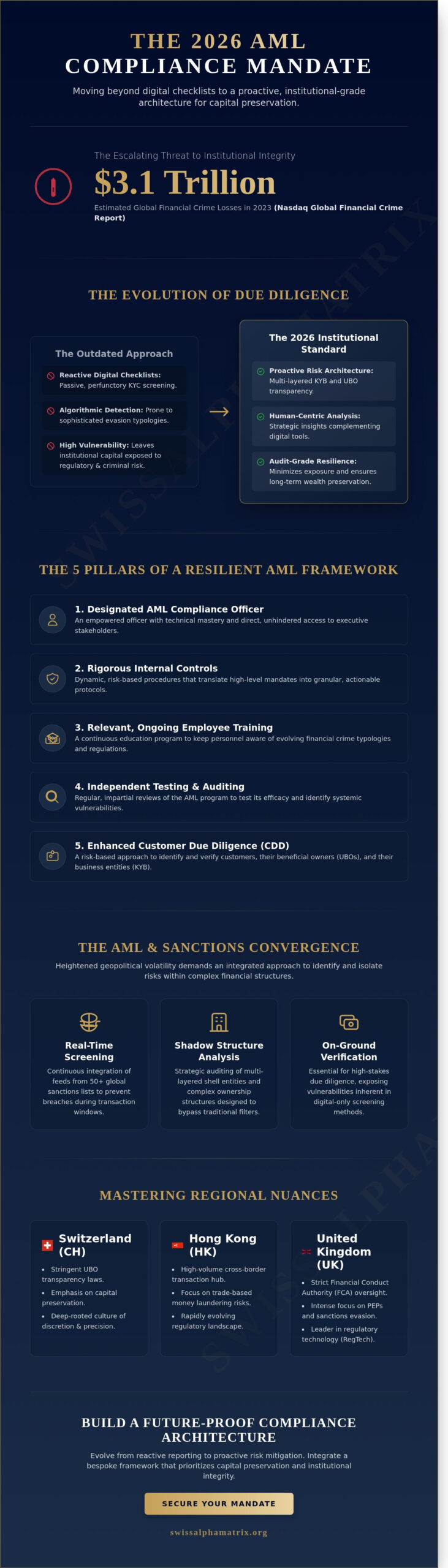
The assumption that sophisticated digital KYC tools alone can safeguard an institutional mandate is a dangerous fallacy in an era where financial crime typologies have evolved beyond the reach of standard algorithmic detection. You’re likely aware that as we approach 2026, the divergence of jurisdictional mandates has created a landscape where a single oversight in aml compliance requirements can jeopardize decades of capital accumulation. With global financial crime losses reaching $3.1 trillion in 2023 according to Nasdaq’s Global Financial Crime Report, it’s clear that a move toward proactive, bespoke risk management is no longer optional for those who value the historical reliability of their institutional structures.
By integrating the strategic insights presented in this guide, you’ll gain the clarity required to navigate fragmented global standards and secure a robust, audit-grade framework for your cross-border transactions. We’ll analyze the critical transition from purely digital verification to a multi-layered, human-centric approach that prioritizes long-term wealth preservation and minimizes regulatory exposure in an increasingly volatile global market.
Key Takeaways
- Transition beyond rudimentary digital checklists toward a sophisticated architecture of KYB and Ultimate Beneficial Ownership (UBO) transparency to meet the heightened institutional standards of 2026.
- Strengthen your internal controls by implementing the five foundational pillars of an institutional program, ensuring your AML Compliance Officer possesses the necessary executive mandate for effective oversight.
- Master the regional nuances governing Swiss, Hong Kong, and UK jurisdictions to ensure your cross-border operations remain aligned with evolving global regulatory trajectories.
- Discover why on-ground verification and physical site visits are essential components of high-stakes due diligence, exposing the critical vulnerabilities inherent in digital-only screening methods.
- Evolve from reactive reporting to proactive risk mitigation by integrating aml compliance requirements into a bespoke architecture that prioritizes capital preservation and institutional integrity.
The 2026 AML Compliance Landscape: Beyond Digital Checklists
The 2026 regulatory environment demands a departure from the perfunctory due diligence of previous decades. Institutions now face Anti-money laundering (AML) mandates that prioritize granular clarity over procedural volume. The transition from basic Know Your Customer (KYC) protocols to rigorous Know Your Business (KYB) and Ultimate Beneficial Ownership (UBO) transparency has become the baseline. This evolution reflects the stringent standards established by the European Union’s 6th and 7th Anti-Money Laundering Directives, which have effectively harmonized global expectations for institutional-grade capital protection. Passive compliance isn’t a viable strategy for those seeking to insulate their portfolios from the volatility of regulatory scrutiny. It’s a matter of strategic survival.
The Escalation of Regulatory Expectations
The Financial Action Task Force (FATF) updates from 2024 and 2025 have fundamentally reshaped national legislations for the 2026 fiscal year. Regulators have expanded their focus to include complex predicate offenses, notably environmental crimes and high-frequency securities fraud, which Interpol estimated to generate over $280 billion in illicit flows annually. AML compliance is a multi-layered defensive architecture designed to preserve institutional integrity. This framework requires an analytical depth that transcends simple automated alerts, focusing instead on the intent and origin of capital. Meeting modern aml compliance requirements involves a meticulous examination of the entire financial lifecycle, ensuring that every asset remains untainted by the increasing sophistication of global criminal enterprises.
The Convergence of AML and Sanctions Compliance
Heightened geopolitical volatility since 2022 has transformed real-time sanctions screening into a non-negotiable component of aml compliance requirements. Sophisticated investors must now prioritize counterparty risk mitigation to identify and isolate risks within “shadow” financial structures often utilized in cross-border capital movements. These structures, while occasionally used for legitimate privacy, frequently mask the involvement of sanctioned entities or politically exposed persons (PEPs).
- Real-time screening: Integration of automated feeds from over 50 global sanctions lists to prevent accidental breaches during transaction windows.
- UBO Identification: Rigorous verification of beneficial owners in jurisdictions where transparency laws remained opaque as recently as 2024.
- Shadow Structure Analysis: Strategic auditing of multi-layered shell entities that attempt to bypass traditional banking filters.
Managing these complexities requires more than just software. It necessitates a bespoke approach to risk that aligns with the historical reliability of Swiss financial excellence. By treating compliance as a strategic pillar rather than a bureaucratic hurdle, institutions can achieve a level of alpha that’s protected by the highest standards of professional integrity. The goal is to move beyond the checklist, fostering a culture of precision that mirrors the traditional discretion of elite private banking.
The Five Pillars of an Institutional AML Compliance Program
The architecture of a resilient defense against financial impropriety rests upon five established pillars, each refined to meet the stringent aml compliance requirements of the 2026 regulatory landscape. At the center of this framework sits the designation of a qualified AML Compliance Officer. This individual must possess not only technical mastery but also unhindered, direct access to executive stakeholders, ensuring that compliance concerns are never secondary to operational velocity. This leadership is supported by the implementation of rigorous internal controls and risk-based procedures that translate high-level mandates into granular, actionable protocols. It’s essential that these controls are dynamic, reflecting the specific risk appetite of the institution while maintaining absolute precision in execution.
To maintain the integrity of these systems, institutional-grade transaction risks require ongoing employee training programs that are bespoke to the specific asset classes and jurisdictions involved. These sessions move beyond rote memorization, focusing instead on the nuance of sophisticated financial structures. A robust program is further fortified by the necessity of an independent audit function to validate effectiveness. Finally, the deployment of sophisticated Customer Due Diligence (CDD) and Enhanced Due Diligence (EDD) protocols remains non-negotiable. These protocols are vital for unmasking the complexities of ultimate beneficial ownership in an era where global capital is increasingly fragmented.
Developing a Risk-Based Approach (RBA)
Moving beyond the antiquated reliance on generic risk scoring, modern institutions must adopt bespoke risk assessment mandates that reflect their unique market positions. This involves integrating risk management frameworks directly into the core AML strategy, ensuring that capital preservation remains the primary objective. By calibrating risk appetites for complex project management, particularly in emerging markets where 2025 data suggests a 14% increase in regulatory scrutiny, firms can navigate volatility with precision. This strategic alignment allows for the intelligent allocation of resources toward the highest-risk vectors. For those seeking to align their portfolios with these high standards, engaging with a partner who understands bespoke institutional mandates is a prudent step toward long-term security.
The Independent Audit: Validating the Shield
Internal reviews, while useful for day-to-day oversight, are fundamentally insufficient for high-stakes cross-border mandates where the margin for error is non-existent. The role of external advisors becomes paramount, providing audit-grade validation of compliance health that satisfies both internal stakeholders and global regulators. According to the SEC AML guidance for institutions, the frequency and scope of independent testing must be calibrated to the firm’s specific risk profile and the inherent volatility of the regulatory environment. In practice, this often necessitates an annual review cycle to ensure that the shield remains impenetrable against evolving financial crimes. These audits provide the empirical evidence required to demonstrate that aml compliance requirements are not merely met but mastered through diligent application and expert oversight.
Regional Nuances: Navigating CH, HK, and UK Requirements
The orchestration of a global capital strategy necessitates a profound, almost surgical understanding of how localized aml compliance requirements intersect with overarching fiscal mandates. Within the tripartite architecture of Switzerland, Hong Kong, and the United Kingdom, regulatory divergence is not merely a bureaucratic hurdle; it represents a strategic variable that dictates the efficacy of cross-border asset mobility. Swiss Alpha Matrix operates at the nexus of these specific jurisdictions, ensuring that the friction inherent in multi-jurisdictional oversight is mitigated through institutional-grade precision and a commitment to long-term wealth preservation. Our approach treats regulatory adherence as a pillar of alpha generation rather than a secondary administrative task.
Switzerland: The Gold Standard of Discretion and Rigour
The Swiss Federal Act on Combating Money Laundering (AMLA) remains the cornerstone of European financial integrity, especially as it evolves toward the 2026 standards of digital asset oversight. By integrating the rigorous expectations of the Financial Market Supervisory Authority (FINMA) with the self-regulatory oversight of the VQF, Switzerland maintains a dual-layered defense that preserves the traditional sanctity of the client relationship. This framework is deeply tethered to international financial regulations; however, it applies a level of Swiss precision that transforms static validation into a dynamic tool for risk-adjusted stability. It’s a system where bespoke mandates are protected by the most stringent verification protocols in the modern era, ensuring that discretion never compromises the integrity of the global financial system. We don’t view these rules as constraints, but as the boundaries that define excellence.
Hong Kong and London: Gateways to Global Capital
Hong Kong’s Anti-Money Laundering and Counter-Terrorist Financing Ordinance (AMLO) serves as a critical bridge, aligning Western transparency with the nuanced liquidity of East Asian markets. Simultaneously, London’s post-Brexit trajectory has culminated in the 2026 enforcement of the Economic Crime and Corporate Transparency Act. This legislation introduces a new era of corporate accountability, requiring firms to monitor “failure to prevent fraud” with a level of granularity that was previously optional. For the sophisticated investor, managing these disparate aml compliance requirements requires more than just a compliance checklist. It demands an architect.
Swiss Alpha Matrix utilizes its physical presence in these hubs to provide localized expertise, ensuring that capital remains both compliant and agile across the world’s primary financial pivots. We manage the inherent friction between these regions by focusing on:
- Harmonized Due Diligence: Standardizing verification across FINMA and AMLO requirements to prevent redundant scrutiny.
- Regulatory Anticipation: Tracking the UK’s shift toward stricter corporate transparency to future-proof portfolios against legislative shifts.
- Bespoke Jurisdictional Mapping: Aligning specific asset classes with the regulatory environment most conducive to their long-term growth.
By maintaining a presence in London, Hong Kong, and Zurich, we provide a unified perspective that respects local law while prioritizing the global objectives of the institution. This ensures that every movement of capital is supported by a foundation of absolute technical accuracy.
On-Ground Verification: The Critical Failure Point in Modern AML
Sophisticated money laundering schemes in 2026 have evolved to bypass even the most advanced AI-driven filters. Digital-only screening often fails to detect “paper-only” entities that exist solely within a ledger. These entities maintain perfect digital footprints; however, they lack any physical infrastructure. Relying exclusively on electronic data feeds creates a dangerous blind spot for institutional investors. True due diligence begins where the database ends.
The Limitations of Algorithmic Due Diligence
Criminals utilize synthetic identities, a practice that increased by 17% in 2024 according to industry reports. These identities blend real and fabricated data to pass automated checks with ease. Meeting modern aml compliance requirements isn’t just about checking a box; it’s about confirming the physical existence of the source of wealth. This often requires examining non-digital records. Historical property deeds or physical ledger books in jurisdictions with limited digital transparency remain essential. Without physical site visits, an auditor cannot verify if a reported “manufacturing facility” is a functioning plant or a vacant lot in a remote province. The gap between “audit-grade” documentation and physical reality is where the highest risks reside.
Operational Due Diligence as an AML Requirement
Meeting rigorous aml compliance requirements necessitates a transition from passive screening to active, on-site observation. Assessing a counterparty’s internal compliance culture isn’t possible through a screen. It requires witnessing their operational workflows in person. Utilizing due diligence advisory services allows firms to identify cultural red flags. These might include a lack of internal controls or informal decision-making processes that don’t appear in digital filings. Integrating these physical checks into the broader project management timeline ensures that compliance isn’t a final hurdle, but a continuous standard of excellence.
Verification of liquidity and high-value assets often involves bank instrument validation services. This specialized subset of AML ensures that the collateral presented is not merely a high-resolution forgery. In a market where 12% of reported financial fraud involves sophisticated document manipulation, physical confirmation at the issuing bank remains the only definitive safeguard. This institutional-grade approach mirrors the traditional discretion and precision of Swiss financial traditions.
- Physical interviews with Key Management Personnel (KMP) to verify professional history.
- On-site inspection of physical assets and inventory to prevent “ghost” valuations.
- Direct verification of bank instruments with issuing officers to ensure authenticity.
- Assessment of local regulatory standing through in-person inquiries with regional authorities.
Protect your capital from sophisticated digital deception by securing bespoke due diligence solutions from Swiss Alpha Matrix today.
Building a Future-Proof Compliance Architecture
The transition from a reactive, reporting-centric posture to one of proactive risk mitigation represents the fundamental shift in institutional governance for 2026. Senior executive leadership must foster a culture where compliance isn’t viewed as a peripheral administrative burden, but as a core component of fiduciary duty. This evolution requires the deployment of independent financial project management to oversee the seamless integration of regulatory protocols within existing operational frameworks. At Swiss Alpha Matrix, we provide the strategic oversight necessary to navigate these complex mandates, ensuring that every layer of the architecture is resilient against the scrutiny of global regulators. By anchoring compliance in the boardroom rather than the back office, firms can transform regulatory obligations into a pillar of institutional stability.
Integrating AML into the Investment Lifecycle
Effective compliance begins long before a transaction occurs; it’s woven into the very fabric of the investment lifecycle. From the initial pre-mandate screening of counterparties to the continuous post-transaction monitoring of capital flows, every stage must align with stringent aml compliance requirements. Institutional fund managers now utilize Form PF as more than just a regulatory filing. It’s a strategic reference point that enhances deal integrity by providing a granular view of systemic risk and liquidity. When compliance is integrated at this level, it doesn’t inhibit the speed of execution; it secures the longevity of the investment by neutralizing potential legal or reputational liabilities before they materialize. This holistic approach ensures that deal flow remains fluid while maintaining the highest standards of transparency.
The Strategic Advantage of Bespoke Advisory
Generic compliance templates frequently fail when applied to the nuances of multi-billion dollar, cross-border transactions. These complex deals require a level of precision that off-the-shelf software cannot provide. The value of insights from former Tier-1 bank executives becomes evident when navigating the regulatory grey areas that define modern global finance. Our approach prioritizes bespoke advisory services that recognize the unique risk profile of each mandate. By moving beyond checklist-based methodologies, we ensure your capital is protected by institutional-grade oversight that anticipates shifts in aml compliance requirements. A comprehensive approach to capital risk mitigation across multi-jurisdictional portfolios is essential to ensuring that every instrument is validated against the highest standards of Swiss-inspired precision. This level of dedication mirrors the traditional discretion of Swiss private banking, offering a steady hand in an increasingly volatile regulatory environment. Secure your capital with institutional-grade oversight and partner with experts who prioritize long-term wealth preservation over short-term expediency.
Securing Institutional Resilience in the 2026 Regulatory Epoch
The 2026 regulatory horizon necessitates a departure from the superficiality of digital checklists in favor of a robust, multi-layered compliance architecture. Success in this heightened environment depends upon the seamless integration of jurisdictional nuances found in Switzerland, Hong Kong, and the UK, alongside a commitment to physical on-ground verification that digital systems often overlook. Meeting the rigorous aml compliance requirements of this decade demands an institutional-grade approach that values precision and technical accuracy above all else.
Swiss Alpha Matrix is led by former Tier-1 global bank executives who bring over 25 years of transactional and regulatory expertise to every engagement. By providing audit-grade instrument validation and bespoke strategic guidance, we ensure that your capital remains protected by the highest standards of Swiss financial tradition. We encourage you to consult with our senior advisors on your complex AML compliance mandates to fortify your operations against emerging global risks. A meticulously structured compliance program isn’t just a regulatory necessity; it’s the foundation of your institution’s enduring reputation.
Frequently Asked Questions
What are the primary AML compliance requirements for institutional investors in 2026?
Institutional investors in 2026 must adhere to the stringent aml compliance requirements established by the Anti-Money Laundering Authority (AMLA), which officially began its supervisory mandate in 2024. These protocols necessitate the integration of real-time transaction monitoring and the rigorous verification of cross-border capital flows. Firms that fail to implement these sophisticated digital architectures risk exclusion from the European Union’s harmonized financial market, as the 6th Anti-Money Laundering Directive mandates a unified rulebook across all 27 member states.
How does Enhanced Due Diligence (EDD) differ from Standard Due Diligence?
Enhanced Due Diligence (EDD) requires a more granular investigation into a client’s source of wealth than Standard Due Diligence (SDD), specifically when dealing with High-Risk Third Countries identified by the FATF. While SDD focuses on verifying identity at a 25% ownership threshold, EDD protocols often demand 100% transparency regarding the origin of assets. This bespoke level of scrutiny ensures that institutional portfolios remain insulated from the legal volatility associated with Politically Exposed Persons (PEPs) or opaque corporate structures.
What is the role of a Money Laundering Reporting Officer (MLRO) in a multi-national firm?
The Money Laundering Reporting Officer (MLRO) serves as the ultimate arbiter of regulatory integrity, holding personal liability for the firm’s adherence to the 40 Recommendations set by the Financial Action Task Force. In a multi-national context, this official synthesizes disparate jurisdictional rules into a single, institutional-grade compliance framework. They ensure that Suspicious Activity Reports (SARs) reach the appropriate Financial Intelligence Units within the statutory 30-day window, maintaining the firm’s reputation for Swiss-level precision in global markets.
Can digital AML screening replace the need for physical on-ground verification?
Digital AML screening can legally replace physical verification provided the technology complies with the eIDAS Regulation (EU 910/2014) or equivalent national standards for electronic identification. Modern systems utilize biometric liveness detection and cryptographic document validation to achieve a level of certainty that often exceeds traditional manual inspections. By 2026, 85% of institutional onboarding processes will likely utilize these remote protocols to maintain efficiency while meeting the most rigorous aml compliance requirements.
What are the consequences of non-compliance with global AML regulations?
Non-compliance with global AML regulations results in severe fiscal penalties, such as the $4.3 billion settlement reached by major exchanges in 2023, alongside the potential revocation of banking licenses. Beyond immediate fines, firms face a lasting de-risking by correspondent banks, which can terminate vital clearing relationships. This loss of market access compromises long-term alpha generation and erodes the trust that high-net-worth clients place in the institution’s role as a wise guardian of their capital.
How often should an institutional risk-based AML assessment be updated?
An institutional risk-based AML assessment should be updated at least once every 12 months, or immediately following any significant change in the firm’s operational profile or client base. The Wolfsberg Group’s 2022 guidance emphasizes that static assessments are insufficient for managing the dynamic risks of 2026. Frequent updates allow firms to recalibrate their risk appetite and ensure that their strategic pillars remain aligned with the evolving typologies of financial crime documented in the latest FATF Mutual Evaluations.
Is UBO (Ultimate Beneficial Ownership) disclosure mandatory in all jurisdictions in 2026?
Ultimate Beneficial Ownership (UBO) disclosure isn’t yet mandatory in every single jurisdiction, but over 100 countries have now committed to the Global Forum on Transparency and Exchange of Information for Tax Purposes. While certain offshore centers maintain levels of opacity, the G20’s 2025 mandate for public registries has made non-disclosure a significant barrier to international trade. Professionals who value discretion must recognize that global transparency is now the baseline for institutional-grade wealth preservation and strategic growth.
How do AML requirements impact the validation of complex bank instruments like SBLCs?
AML requirements necessitate a forensic validation of the underlying assets and the issuing institution’s standing when processing complex bank instruments like Standby Letters of Credit (SBLCs). Compliance teams must verify the MT760 SWIFT messages against the International Chamber of Commerce (ICC) UCP 600 standards to prevent the facilitation of fraudulent credit enhancement schemes. This rigorous validation process ensures that these bespoke financial tools aren’t utilized as vehicles for layering illicit funds within the global banking system.