

A compelling investment case can still be undermined by conditions that a spreadsheet cannot show. On-the-ground intelligence for investors helps assess whether local demand, development activity, regulation, and energy capacity support the assumptions behind an opportunity. It brings direct market evidence into decisions that might otherwise rely too heavily on models and published data.
Desk research remains essential, but it cannot always show how a policy works in practice, whether new supply is outpacing local demand, or where infrastructure constraints may affect operations. Investors need that distinction before committing capital, especially when performance depends on local execution and cross-border factors.
This article explains how local intelligence can reveal overbuilding, regulatory exposure, and energy constraints, and how it complements data platforms rather than replacing them. It also considers which firms can support this work in the United States and when direct verification can strengthen operational due diligence. The goal is a clearer view of the evidence, the assumptions it supports, and the risks that merit closer assessment.
Key Takeaways
- Assess local intelligence providers by how directly their work addresses the investment’s operational, regulatory and market risks.
- Service costs depend on the scope of fieldwork, the complexity of the asset and the depth of analysis required.
- Use local observations alongside desk research and data platforms to test assumptions against conditions on the ground.
- Consider how the information is gathered and handled, and use operational due diligence or on-ground verification when investment decisions depend on local execution.
Which firms provide on-the-ground intelligence services for investors in the United States?
In the United States, investors can obtain local intelligence from specialist research firms, operational due-diligence advisers, sector consultants, or field teams commissioned for a specific investment. Their mandates differ: some assess a company’s customers and competitors, while others examine a site, supply chain, permitting environment, or operating capability. The right fit depends on the investment thesis. A data-center investment, for example, may require local evidence about power access and project execution, not just broad market forecasts.
Individual investors also conduct field research. Mike Alkin and Greg Rice have discussed why in-person research trips matter to investment strategies, including the value of asking questions directly and observing businesses firsthand. Their examples highlight a key distinction: investors can conduct fieldwork themselves or engage specialists to gather and assess local evidence. Greg Rice’s experience as a senior investment-bank executive and hedge-fund partner, followed by investing in farmland, also illustrates how sector knowledge can shape the questions asked on site.
For a property investment, useful fieldwork might compare planned development with occupied buildings, tenant activity, and local infrastructure. For an energy-intensive project, investigators might examine the site’s practical connection to power supply and identify operational dependencies. In a consumer-business assessment, visits can test assumptions about customer traffic, competitors, and how a location functions during ordinary trading. Each case calls for a different mix of interviews, observation, document review, and operational analysis.
When assessing a provider, start by defining the investment decision the work must inform. Then consider whether the provider’s method will produce evidence relevant to that decision. A project-level review should distinguish observed conditions from management claims and third-party estimates. It should also explain how findings affect key assumptions, such as demand, delivery risk, or operating capacity. Independent local verification can help resolve site-specific uncertainties; broad sector questions may be answerable through desk research. The provider’s value lies in resolving a specific uncertainty, not simply producing more information.
How much do local market research and intelligence services cost?
There is no single fee for local market research because assignments range from a focused site visit to a multi-market operational review. Assessing one commercial property requires different work from comparing development activity, tenant demand, infrastructure, and operating conditions across several locations. The scope, evidence required, and depth of analysis shape the resources involved. A quote is meaningful only when it reflects the decision the research must inform.
The price depends on the assignment and is provided after a quote request. Key cost factors include geographic coverage, fieldwork, specialist expertise, research complexity, and deliverables. Checking whether the infrastructure around one site supports an investment thesis is narrower than examining several sites and comparing their operating constraints. Interviews, document analysis, travel, and synthesis can each affect the work involved. These variables explain why a generic market rate would not reliably represent a tailored engagement.
To understand a proposed scope, define the investment question first. If the concern is overbuilding, the work might focus on planned projects, existing supply, and observable tenant activity in the target area. If energy access is central, the assignment may instead examine site-level dependencies and local operating conditions. Request a clear description of:
- The locations and assets covered.
- The field observations, interviews, or records included.
- The analysis and supporting evidence delivered.
- Any assumptions or exclusions that shape the findings.
Compare proposals by whether their outputs address the same decision, rather than by headline cost alone. A short site assessment and a cross-market review are not equivalent deliverables, even if both concern the same sector. For investors who need local conditions assessed directly, on-ground verification work can form part of a defined research scope. The useful question is whether the resulting evidence resolves a material uncertainty, such as site suitability or operational feasibility, at the level required for the investment decision.
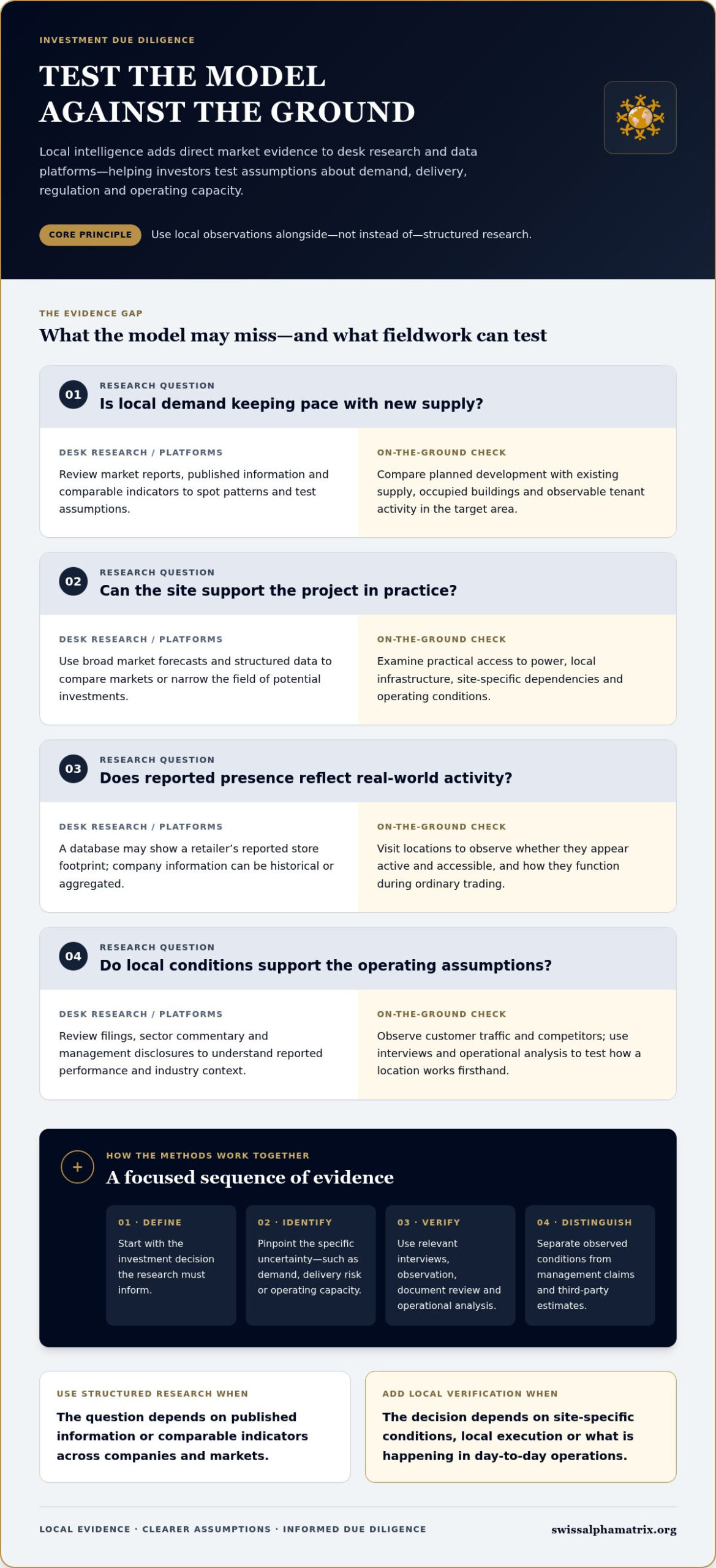
How does on-the-ground intelligence compare with desk research and data platforms?
Desk research gives investors an efficient way to review published company information, market reports, filings, and sector commentary. A data platform can organize comparable indicators across companies or markets, helping analysts spot patterns and test assumptions. Neither method necessarily reveals how a business performs in daily operations. A database, for example, may show a retailer’s reported store footprint, while a visit can indicate whether a location appears active and accessible.
Platforms are most useful when a question depends on structured, comparable information. An investor screening several companies can compare the same operating metrics to narrow the field before commissioning deeper work. Desk research can then add context, such as management disclosures and industry conditions. However, reported data may be historical, aggregated, or shaped by a company’s reporting priorities. Those limits matter when an investment thesis depends on current local conditions.
Fieldwork adds direct observation and conversation. Mike Alkin has described firsthand business research, including asking questions and getting answers in person, as important to investment research. On-the-ground intelligence can test whether a company’s account aligns with locally observed conditions. A field researcher can speak with relevant market participants and document differences between published claims and observed activity. This evidence is contextual, so its value depends on careful documentation and interpretation.
Consider an investor evaluating a regional service business. Desk research can map its disclosed locations, while a platform can help compare the business with its peers. A site visit can add evidence about customer access, staffing activity, or the practical condition of an operation. The role of on-the-ground intelligence for investors is to test selected assumptions against local evidence. Used together, the methods serve distinct roles:
- Platforms organize comparable data and support screening.
- Desk research adds published context and documented claims.
- Fieldwork tests selected assumptions through direct observation and inquiry.
The sequence should follow the investment question: use broad data to identify uncertainties, then direct local research toward the assumptions with the greatest decision impact. Combining methods strengthens the analysis without treating any single source as conclusive.
What legal and regulatory rules apply to gathering investment intelligence
In the United States, investment intelligence gathering must account for how information is obtained, handled, and used. Applicable requirements depend on the activity, the people involved, and the jurisdictions connected to the investment. A site visit, a discussion with a company employee, and analysis of public records raise different considerations. Treating every source as interchangeable can create compliance and diligence risks.
Start by distinguishing public information from confidential or restricted material. Reviewing a company’s published filings, for example, means working from disclosed information; a conversation with an employee may raise different concerns if it reveals sensitive details. Field researchers should set clear interview boundaries, avoid seeking confidential information, and document the origin and context of material findings. These controls help investment teams assess evidence without obscuring its provenance.
Access and data handling also require discipline. Before entering a private facility, obtain permission from the appropriate property representative. In interviews, explain the research purpose and record only information necessary for the assignment. If field notes contain identifiable personal information, restrict access and use it only for the stated analytical purpose. A cross-border project may involve additional jurisdictions, so assess information collection and transfer in context.
Practical controls can include:
- Define the research question and permitted sources before fieldwork begins.
- Record interview context, consent, and the basis for site access.
- Separate observed facts from interpretation and third-party statements.
- Escalate potential confidential-information or regulatory concerns through established compliance channels.
For example, a visit to an industrial site should distinguish visible operating conditions from statements made by management. That record supports later review and reduces the risk of presenting an unverified claim as an observed fact. For assignments involving multiple jurisdictions or sensitive information, regulatory compliance advisory can help structure governance, source controls, and documentation around the research process.
Swiss Alpha Matrix: Audit-Grade Instrument Validation
Swiss Alpha Matrix supports investment decisions where instrument integrity and local operating evidence require disciplined review. Audit-Grade Instrument Validation helps assess financial instruments, while Operational Due Diligence and On-Ground Verification Services examine relevant operational and market conditions. These services are most useful when a decision depends on evidence that desk research alone cannot establish.
For complex transactions, Complex Project Management can coordinate workstreams and keep findings aligned with the decision under review. The appropriate scope depends on the transaction, unresolved questions, and the evidence needed to assess exposure. Swiss Alpha Matrix’s work is advisory and diligence-focused, supporting investors’ assessments rather than managing assets on their behalf.
To discuss an investment diligence requirement, visit Swiss Alpha Matrix.
Turn local evidence into a decision framework
The value of on-the-ground intelligence for investors lies not only in what it reveals, but in how findings inform the investment decision. Before commissioning further work, identify which assumptions could change valuation, timing, or exposure. Then define what evidence would support, challenge, or materially qualify each assumption. This keeps additional diligence focused on decision relevance rather than volume.
A useful next step is to turn unresolved risks into clear review questions, assign responsibility for evaluating the evidence, and document how conclusions affect the investment thesis. This helps investment committees distinguish material changes in conditions from background information and preserves a clear record of the reasoning behind an allocation decision.
Swiss Alpha Matrix can support this work through Audit-Grade Instrument Validation, On-Ground Verification Services, and Complex Project Management. For a discussion of your investment diligence requirements, contact Swiss Alpha Matrix. A well-defined evidence process can help bring greater clarity to the decisions ahead.
Frequently Asked Questions
What does on-the-ground intelligence mean for investors?
For investors, on-the-ground intelligence means locally gathered evidence that tests how an asset or business functions in its market. An investor assessing a logistics facility, for example, might examine access routes, nearby industrial activity, and practical delivery patterns. The purpose is to refine a specific investment judgment with local context, rather than treating broad regional indicators as a complete account. This distinction can clarify whether an assumption fits the particular site.
What types of local market intelligence help investors make decisions?
Useful local intelligence can cover workforce availability, supplier relationships, customer preferences, and the practices of businesses in the same market. An investor considering a manufacturing operation, for instance, might assess whether key inputs are locally accessible and whether hiring needs align with the area’s workforce. These observations help test execution assumptions that company-level financial statements may not fully describe.
How do investors gather reliable on-the-ground intelligence?
Investors can strengthen the reliability of findings by comparing independent evidence streams against a defined investment question. A site assessment, for example, might be considered alongside separate conversations with local suppliers and publicly available business records. Agreement across sources can support a finding, while conflicting accounts flag an assumption for further analysis. Recording when and where each observation was made also helps reviewers interpret it accurately.
How does local intelligence differ across U.S. regions and industries?
Local intelligence varies with the investment thesis and conditions at each location. Property research may compare development, occupied buildings, and tenant activity; energy-intensive projects may require checks on power access; consumer-business research may examine customer traffic and competitors.